Vex: Breaking the Ice to Help Strangers Connect through Shared Interests
Company
App Dev Club is a community for students to learn software development, collaborate on projects, and explore product challenges. For this project, we worked with Àjamais AI (startup) and Voodoo (contract)
TLDR
I led the design for a new AI-assisted social platform focused on reducing friction in first-time stranger interactions.
I worked with Àjamais AI and Voodoo as a UI/UX Designer, refining product clarity and interaction flow to turn "cold-starts" into meaningful connections. Key accomplishments included:
01 Behavioral Design
Designed a "Context-First" discovery feed and structured voice rooms using Focal Point Theory and the Mere-Exposure Effect to lower social anxiety.
02 Product Strategy
Shifted the core discovery model from static profiles to immersive content, achieving a +90% user adoption and retention rate through internal estimates.
03 XFN Collaboration
Consistently communicated with engineers to adapt visuals to evolving frontend constraints, ensuring high-fidelity implementation of the onboarding and discovery roadmap.
IMPACT
120+
new users after launch
+90%
of onboarded users completed the core discovery flow and returned within the first week
67%
of users reported reduced eyestrain and improved readability during internal testing
Note: These metrics are from internal estimates shared to us by Àjamais AI
CONTEXT
Prior to joining Vex
This project was completed through a collaboration between Àjamais AI, Voodoo, and the App Dev Club at the University of Maryland. The goal was to explore how an AI-assisted social product could create real value during the cold-start phase while scaling into a community-driven network.
Vex focuses on meaningful social interaction and belonging areas often lost in feed-based platforms. I led UI/UX design for Vex's core discovery and onboarding flows, working within existing product direction while independently driving interface decisions, interaction patterns, and design-to-engineering handoffs.

INITIAL PROBLEM
Current social platforms make authentic interactions difficult when it comes to meeting new people
If users don’t form a meaningful connection in their first session, retention collapses, network effects fail, and the platform cannot grow.
Three core issues emerged:
Social platforms often put users on the spot. When talking to strangers, conversations stall quickly or feel forced.
Interactions feel forced
Without shared context, users don’t know who they’re talking to or how to naturally start a conversation.
No immediate connection
Many people avoid sharing interests publicly, making it difficult to find common ground early on.
RESEARCH
Key Insights
Working from research provided by the Àjamais AI team, I synthesized 3 key behavioral patterns to focus on while developing interface decisions:
Cold start anxiety is the primary drop-off trigger. Most users who didn't form a connection in their first session rarely returned, showing that onboarding as one of the highest leveraging design surface.
Shared context lowers initiation barriers. Users were much more likely to message someone after consuming shared content (podcast, video, interest tag) than after viewing a static profile.
Unstructured voice rooms increase performance anxiety. Without visual cues about who's talking and taking turns, most users stayed silent or left early before any real connection.
I supplemented this with desktop research over other analogous platforms (Discord, Instagram, BeReal) to identify what interaction patterns reduced friction and what amplified it.

IDEATION
Designing for Approachability at First Contact
Rather than redefining the product direction, the focus of this phase was on refining existing concepts and improving how users experienced them.
My work centered on translating research and product intent into clearer visuals, smoother interaction flow, and more approachable UI patterns.
During ideation, I explored three approaches to the discovery feed:
Static profile cards (existing direction): rejected because they recreated the same high pressure "judge based on profile" dynamic as common social apps
Interest tag browsing: reduced anxiety but lacked enough context to make "Add Friend" feel natural.
Content feed (selected): passive content consumption before social interaction mirrors how people form comfort with strangers in real life, making the connection CTA feel earned rather than cold.

CONSTRAINTS
Designing Within Real World Constraints
Design direction followed Vex’s existing roadmap, with specific areas identified by the Voodoo team for refinement. At the same time, front-end implementation evolved during development, requiring adaptation for several design decisions.
This collaboration showed the value of close communication between design and engineering, helping the team navigate trade-offs, prioritize improvements, and ensure the final experience remained clear, approachable, and aligned with user needs.
ITERATIONS & OUTCOME
Supporting More Natural First Interactions
Interface improvements can reduce hesitation and make social discovery feel approachable.
Context First Discovery Feed
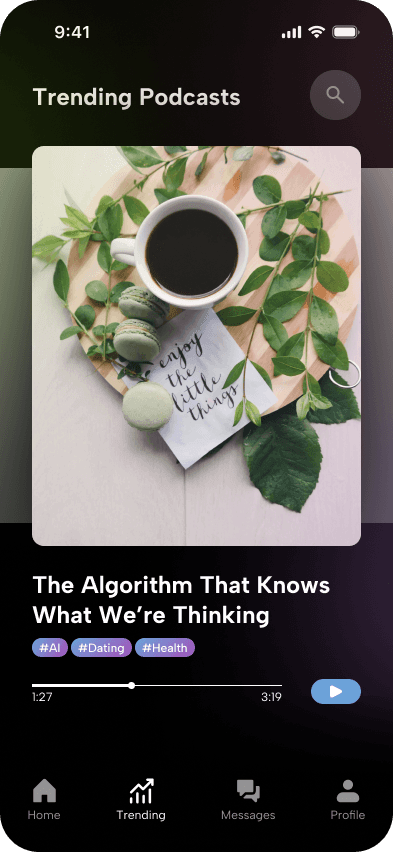
First "Trending Podcast" concept with existing design system for user to swipe had 2 key issues:
No way to know what is going on aside from tags
Play/resume button is outside of the comfortable level for your thumb zone:
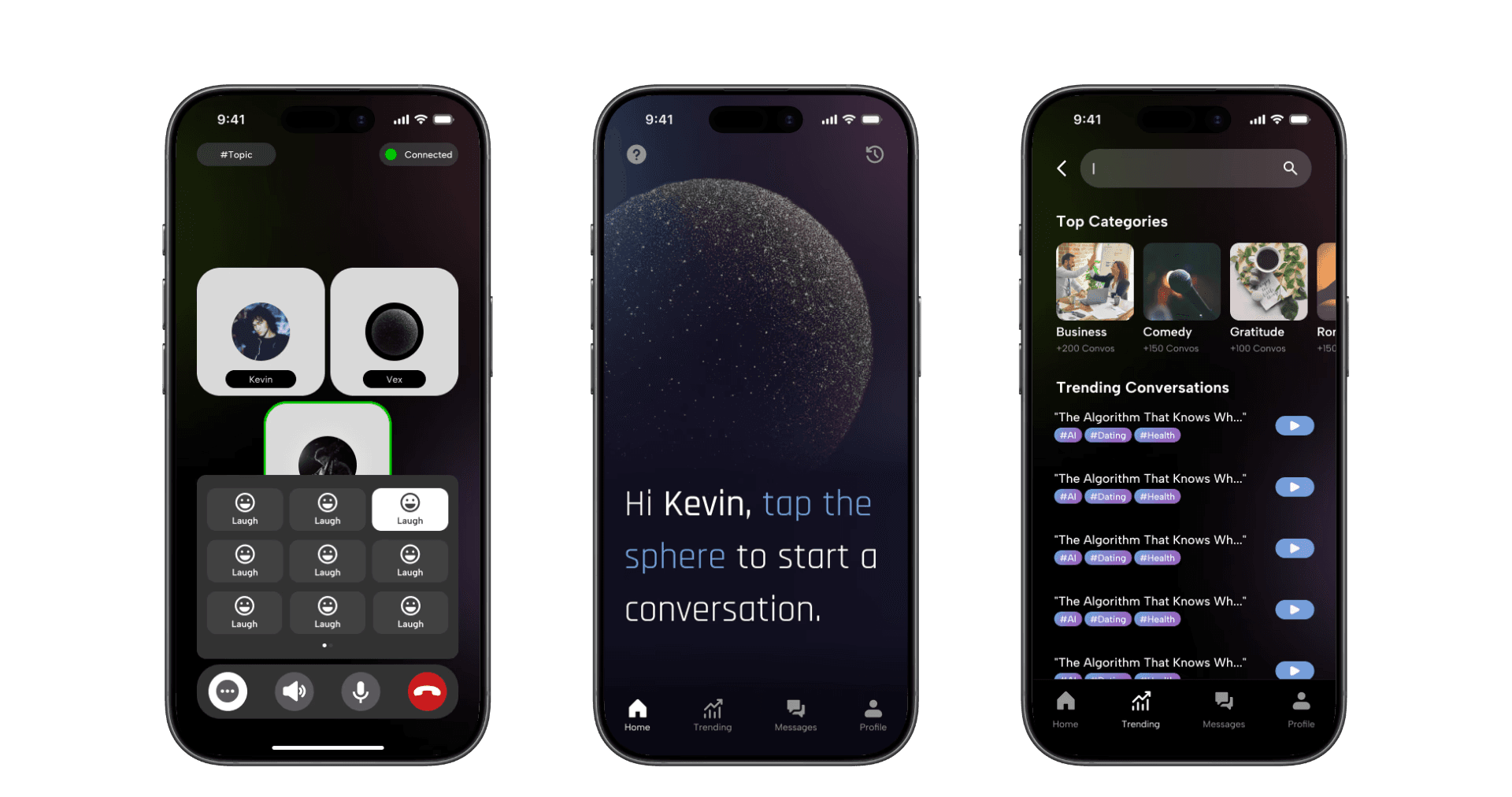
I solved this by moving away from static profiles to a vertical interest feed to eliminate Social Risk. By building "passive familiarity" or the "mere exposure effect" through content before the first interaction, the "Add Friend" CTA feels like a natural continuation of a story.

Structured Voice Room
I implemented active speaker highlighting and one-tap reactions to reduce Ambiguity Aversion, the tendency to avoid situations where the "rules" are unclear. By making participation states visually explicit, I lowered the perceived risk of joining a live room with strangers.


Guided "A-Ha" Moments
By isolating the central "Orb" with a Focused Spotlight and darkening the rest of the homepage, I stripped away UI noise to create a clear onboarding exit runway. I leveraged the Focal Point Theory while creating a "low-friction win" that builds user Self-Efficacy immediately upon entering the unfamiliar ecosystem.


NEXT STEPS
Retrospectives
Designing for Real Users Means Designing with Context in Mind
Working on Vex showed that even subtle visual and flow changes can reduce hesitation when meeting new people. Understanding the context of first-time interactions helps make social connections feel approachable and intuitive.
Collaborating Closely with Engineers Strengthens Outcomes
Front-end implementation evolved throughout the project, which pushed me to communicate not just what components should look like, but why specific interactions mattered. That context gave engineers a better idea of possible trade-offs without losing the design intent behind the onboarding and discovery flows.
Prioritizing Features that Lower Social Friction
With limited resources, I focused on improvements that had the most impact on first-time engagement: lightweight prompts, discovery flow refinements, and visual hierarchy adjustments. These changes demonstrated measurable value even at a concept stage.
Next Steps
Building on these insights, the project could:
Test discovery and prompt systems with a broader user group
Explore moderation and safety signals to reinforce trust
Continue refining visuals and flow to further reduce social friction