
Transforming Daily Routes into Motivation for Healthy Habits
Company
Narb is a human centered AI company that builds intelligent platforms designed to augment human capability.
Role
Product Design Intern
Timeline
Jul. 2025 - Mar. 2026
Tools
Figma
Photoshop
TLDR
I collaborated with UX and behavioral design for a location-aware habit-building platform focused on reducing the friction of manual tracking.
Working as a Product Design Intern, I pivoted the product from a manual logging tool to a passive reinforcement system that meets users at the "moment of decision." Key accomplishments included:
01 Behavioral Design
Developed a "Passive Recognition" system using location-triggered "Side Quests" and Implementation Intentions to eliminate the "data entry chores" that cause 90% of habit app abandonment.
02 Product Strategy
Successfully advocated against a high-friction "active gaming" model in favor of background utility, reducing user cognitive load while maintaining engagement through Variable Rewards.
03 XFN Collaboration
Reduced internal usability issues by 22% through iterative testing with the design system. Developed design foundation that was scalable for backend integration
CONTEXT
Our Vision for nHabits
nHabits is an app for personal habit-building designed to explore how real-world context could better support intentional living. The project began as an investigation into why many habit-tracking tools struggle to sustain long-term engagement, particularly for users trying to align their daily actions with their health, ethics, or personal values. I worked on nHabits as a product and UX designer, defining the product direction, experience principles, and core user flows.
The initial phase focused on research, framing the problem space, and designing an end-to-end experience under technical constraints. While development dependencies delayed full implementation, the project established a clear product vision and design foundation that could scale as engineering support becomes available.
INITIAL PROBLEM
Habit-tracking apps exist, but they’re often abandoned after initial use.
Apps that fail to influence a user's choice become a digital chore. This leads to high abandonment, low retention, and a failure to drive real behavioral change.
Through surveys and habit research, three key issues emerged:
PAST SOLUTIONS
Why Existing Habit-Tracking Apps Fell Short
Most habit-tracking apps rely on manual logging and generic reminders. Feedback often arrives after decisions are already made, reducing its ability to influence behavior. Without real-world context, progress feels abstract, and motivation fades quickly.
As a result, users disengage not because they lack discipline, but because the tools fail to support in the moment.
RESEARCH
Understanding Why People Abandon These Apps
To understand habit abandonment, I interviewed 14 people experiencing consistency challenges, gathered quantitative insights from 61 survey respondents, and evaluated 3 competitors to uncover unmet behavioral and contextual needs.
Methods: Qualitative Interviews, Quantitative Surveys, Desk Research
Key Findings:
Quantitative Research

Desk Research

MyFitnessPal
MyFitnessPal is a health and fitness app that focuses on logging your calories, exercise, as well as helping users meet healthy goals.
Pros
Quick barcode scanning to search for food.
Relatively simple dashboard to show daily progress.
Cons
No real gamification or motivating elements other than being able to count your calories (relies heavily on user to stay disciplined).

Duolingo
Duolingo is a gamified language learning app that encourages consistent learning using their point systems, streaks, and small lessons.
Pros
Vibrant colors as well as many cartoon like illustrations make it fun for everyone.
Push notifications, streaks, levels, and leaderboards keeps people motivated to continue.
Cons
Notifications feel a little excessive at times.

Waze
Waze is a real-time navigation app that helps their users avoid traffic, report crashes, and get route updates using user submitted data.
Pros
Clean map interface that has simple traffic data, making it intuitive.
Has real time visual alerts with voices to make sure you’re cautious while heading to your destination.
Cons
Overlays can end up cluttering the screens and distracting you.
INSIGHTS
Habits Fail When Feedback Comes Too Late
The problem wasn't that users didn't want better habits, but rather that the tools failed to meet the users at the moment of decision. Habits are not formed inside an app; they're formed through consistent real-world contexts. The reinforcement should be able to aid the physical world.
The Pivot: Passive vs. Active Engagement
The product team initially pushed for a "Pokémon GO" model, requiring users to actively "capture" habits on a map to boost engagement. However, my research showed that "data entry chores" are the #1 cause of abandonment.

I communicated my concerns that forcing active play during a busy commute can create cognitive overload for the user. I successfully shifted the strategy to passive recognition using location-triggered "Side Quests" that reward existing behavior with little to no manual friction.
IDEATION & SOLUTION
Progress That Moves With You
Instead of improving habit tracking, nHabits focuses on context-aware reinforcement.
Location-based habit recognition
Habits are tied to physical locations, allowing the app to surface feedback when users are most likely to act.
Gamified reinforcement tied to action
Points, streaks, and progress are earned through real-world behavior, not manual input.
Social accountability through visibility
Leaderboards and shared progress introduce accountability without requiring constant check-ins.
ITERATION
From Tracking to Reinforcement: Iterating the Habit Experience
An iterative exploration of how small interface improvements can reduce friction, clarify progress, and strengthen the habit feedback loop.
Location-Based Quest Hub
To reconnect habits with real life and strengthen long-term motivation, I gave them a physical location on a live map that has actionable hubs. This closes the gap between digital goals and the real world, turning habits into spatial and tangible opportunities for progress.

Real-Time "Moment of Decision"
Instead of requiring manual check-ins, the app detects proximity to the gym and surfaces a lightweight, high clarity decision (“Go Now” or “Maybe Later”) paired with immediate XP reward feedback. This reduces friction at the decision point and shifts habit tracking from reflection to action.

Gamified Momentum
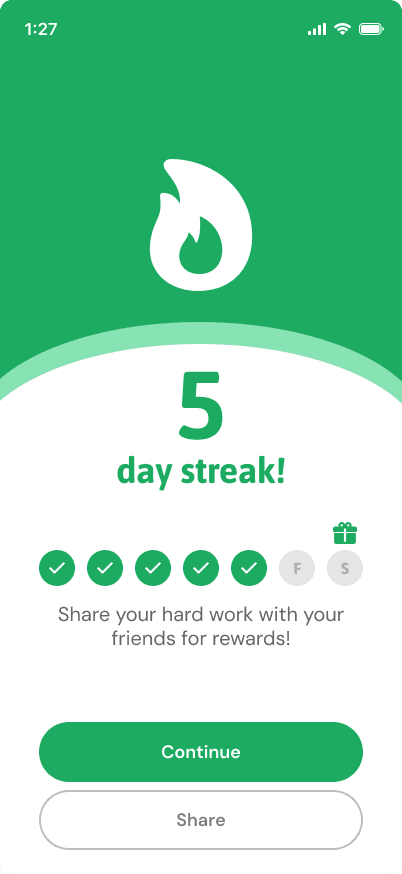
A high-contrast streak screen to celebrate daily consistency and solve for the lack of long term motivation. This uses visual rewards to make users reluctant to break their hard earned progress. The "Share" feature further encourages social reinforcement to maintain engagement with the user.
Social Accountability
A group-based system where users earn XP for time spent at "Habit Zones" set by the group manager. This gives a level of personalization. By showing the number of "People" active, social proof transforms a chore into a shared win.

OUTCOME
Positive feedback from both participants and company
The early feedback was very positive, users mentioned that the app could reduce the friction when forming new habits.
Full quantitative measures are delayed until backend integration is complete.
"This might actually make me follow my routines now that I see it as a fun game instead of something I need to do."
Eileen Jiang, Early nHabits tester
REFLECTION
My Takeaways and Future
Working on nHabits with the Narb design team reinforced how crucial it is to design solutions that can actually be built. Thoughtful flows, edge case handling, and clear specifications ensured our prototypes translated into functional, user-ready features. I also learned how small design decisions, like progress feedback and simplified flows, can make a big difference in user engagement and habit adoption.
Looking ahead, I plan to onboard early users, test reward systems and adaptive nudges, and refine habit tracking flows. This will help validate solutions, improve retention, and push for a full product release.